Walled cities & historic centers
Ávila, Segovia, Salamanca, Zamora and Ciudad Rodrigo make it easy to build a route around monumental cities without repeating the same kind of stay.

Castles, walled cities, monasteries and some of the strongest Parador-to-Parador road trips in Spain.
Castile and León has one of the largest concentrations of Paradores in the Atlas. Ávila, Segovia, Salamanca, Zamora, León and smaller historic towns make this region particularly strong for travelers who want architecture and history to shape the route.
Castile and León has one of the broadest Parador networks in Spain. Walled cities, monumental town centers, former palaces and castles sit alongside mountain and countryside properties, making the region especially good for self-drive travelers who want the route itself to connect history, architecture and landscape.
Ávila, Segovia, Salamanca, Zamora and Ciudad Rodrigo make it easy to build a route around monumental cities without repeating the same kind of stay.
León, Lerma, Ciudad Rodrigo and Zamora are strong choices when the architecture and history of the Parador itself are central to the experience.
Gredos, Cervera de Pisuerga and Puebla de Sanabria bring mountain scenery, open country and a slower pace into an otherwise city-led itinerary.
León and Villafranca del Bierzo work naturally in journeys toward Galicia, while Benavente and Puebla de Sanabria help connect the western side of the region.
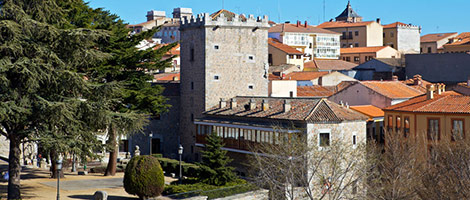


An Impressive spot surrounded by Nature and Romanesque Features


A stone building in the heart of Sierra de Gredos

Royal palaces in the shelter of the mountains

16th Century Monastery-Hospital


Stopping point and meeting place along the way

15th Century Renaissance Palace and Aliste built his Palace...
This is a region where geography matters as much as the building. Decide first whether you want monumental cities, a landmark historic stay, mountain scenery or a route that carries you west toward Galicia.
León’s Hostal de San Marcos is the obvious headline choice, while Lerma, Ciudad Rodrigo and Zamora give you very different historic settings without leaving the region.
Segovia, Ávila and Salamanca are especially useful first choices for travelers who want major monuments, walkable historic centers and easy links between stops.
Gredos and Cervera de Pisuerga put landscape at the center of the stay, while Puebla de Sanabria combines a smaller historic town with access to the greener northwest.
León and Villafranca del Bierzo make a natural pair on the way toward Galicia. Benavente and Puebla de Sanabria can extend the route through western Castile and León.
The region is large, so the best itineraries concentrate on one corridor at a time. These route frameworks favor sensible geography over trying to cover the entire Parador collection in one trip.
A strong first route through some of Spain’s best-known historic cities, with manageable transitions and a clear architectural progression from one stop to the next.
A quieter route across the Castilian plateau, linking historic towns and the Duero corridor without relying on the region’s most obvious headline destinations.
A practical westbound sequence for travelers continuing toward Galicia, with León as the monumental anchor and increasingly greener landscapes as the route progresses.
A compact route that works well before or after Madrid, combining royal La Granja, monumental Segovia and the mountain landscape around Gredos.
Use the interactive map to compare each stop geographically, then open individual Parador pages for nearby properties and room availability.
Paradores Atlas currently lists 15 Paradores in Castile and León, making it one of the strongest regions in Spain for building a multi-stop Parador route.
León is a standout when the historic building itself matters most. Segovia, Ávila and Salamanca are excellent for first-time regional itineraries, while Gredos or Cervera de Pisuerga add landscape and a slower pace.
Yes. The region is large enough for several different trips. A focused three- or four-stop route usually works better than trying to connect every Parador in one journey.
León and Villafranca del Bierzo are natural western stops, with Puebla de Sanabria useful for a more southerly route toward Galicia.
Spring and autumn are especially comfortable for historic-city routes. Winters can be cold, particularly at higher elevations, while summer days can be hot across the plateau even when evenings are cooler.
Browse curated multi-Parador itineraries or return to the map to see what lies beyond the regional boundary.