

Why stay here?
A grand ducal palace Parador dominating Lerma’s main square, with courtly scale, nearby wine country and easy access to Burgos.
Why it stands out
The palace has the scale and symmetry of a royal court residence, making the building itself the principal attraction.
How long to stay
One night works well on a through-route; two nights are better for Covarrubias, Silos or Arlanza wine country.
Best route role
Use Lerma between Madrid/Segovia and Burgos or as a deliberate palace stop on a Castile route.
The Duke of Lerma’s early-17th-century palace
The Parador occupies the Ducal Palace of Lerma, built in the early 17th century for Francisco Gómez de Sandoval y Rojas, the first Duke of Lerma and powerful favorite of Philip III.
Its large central courtyard and formal palace proportions make this one of the network’s clearest examples of a courtly residence converted into a Parador.
A small Castilian town with royal-scale architecture
Lerma sits south of Burgos and within reach of Covarrubias, Santo Domingo de Silos and Arlanza wine country. The palace gives the town a scale that feels much grander than its size.
More about the stay
The Ducal Palace is located in the highest part of the town of Lerma. It was constructed taking advantage of the site of a 10th century castle and was implemented according to the plans of the architect Francisco de Mora in successive phases between the years 1601 and 1617. The palace was commissioned by the order of the first Duke of Lerma, Francisco Gómez de Sandoval y Rojas for the accommodation, rest and general enjoyment of his master, King Philip III.
This Parador has a central courtyard surrounded by columned galleries in alternating sections: the first has twenty Tuscan columns with semicircular arches, and the second has twenty Ionic columns.
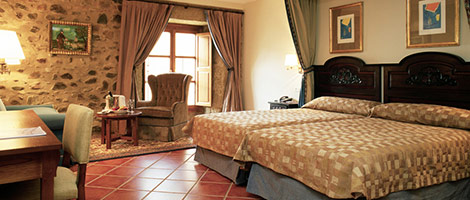
After its restoration the Palace has now been converted into a Parador with 70 rooms and a capacity of 133 beds.
Is Parador de Lerma right for your trip?
Travelers who want a grand palace stay in a small town.
Road-trippers moving between Madrid, Segovia and northern Castile.
Visitors interested in Burgos province, monasteries and wine country.
Place this Parador in Castile and León
Castile and León has one of the largest concentrations of Paradores in the Atlas. Ávila, Segovia, Salamanca, Zamora, León and smaller historic towns make this region particularly strong for travelers who want architecture and history to shape the route.
Explore all Paradores in Castile and León →Start here. Then fan out.
Use the local map for geographic context, then compare the nearby Paradores below before deciding where the route should go next.
What to see nearby
- Covarrubias (22 km.)
- A beautiful town founded by count Fernán González in the year 987.
- Of note is the Collegiate Church of San Cosme y San Damián (15th c.), an important example of a Gothic church of the best of the Burgos school.
- Church of Santo Tomás (12th c.).
- Doña Urraca Square.
- Doña Sancha Square.
- Quintanilla de las Viñas (35 km.)
- 7th century Visigothic church.
- Not far from here it is worth visiting the Romanesque San Quirece Abbey founded by Count Fernán González.
- Sierra de la Demanda (45 km.)
- An extraordinary mountain range in the southeast of the province.
- In the shadows of its majestic and almost always snow-capped peaks a series of scenic and human elements come together which make the area an attractive natural and tourist paradise.
- There are glacial lakes and sites with dinosaur and tree fossils.
- St. James’s Way.
- The strategic geographical situation of the territory that now makes up the province of Burgos has made it an obligatory step for the pilgrims from all over Europe who leave their home countries in search of the tomb of Saint James.
- Visits to the D.O. Arlanza Wine Cellars close to the Parador.
- Distancia de Santo Domingo de Silos (31 km.)
- The 18th century Monastery of Santo Domingo where one can enjoy the GREGORIAN CHANTS of the monastery’s monks.
- The Yecla Gorge is also nearby.
- Burgos (36 km.)
- The old districts are presided over by the Gothic Cathedral with its enchanting small towers and spires.
- Surrounding the Cathedral are the Gothic Churches of San Esteban, San Gil, San Nicolás and Santa Águeda.
- On the outskirts of the town is the splendid complex of the Royal Monastery of las Huelgas and the Miraflores Charterhouse.
- Lerma.
- Ducal Palace.
- Convent of San Juan.
- Santa Clara Square.
- Santa Clara Convent.
- Church of San Pedro.
- Peidad Sanctuary.
- Arco de la Cárcel (entry gate of the ancient Medieval city wall from the 9th century).
- Convent del Carmen.
- Convent de San Blas.
- Sierra de Atapuerca (51 km.)
- Important archaeological sites with human remains dating back more than a million years, where the first settlers of the continent now known as Europe lived.
Activities and ways to spend your time
- Golf course "Golf Lerma" (5 km.)
Regional flavor
Of note are the cold meats such as the morcilla (blood sausage) and the Burgos cheese. Let us not forget the freshwater fish including the trout, and the arriero-style stews such as the ajo carretero or pastor, customarily accompanied by the traditional ‘Torta de Aranda’ bread. A must is the tasting of the roast suckling lamb cooked in a wood-fired oven, prepared with patience and affection, as well as the palatial-recipied desserts such as the ‘cañas del duque rellenas de crema de vainilla’, the quince cake and ‘dulcería en sarten’.
Before you build the stay into your route
Use the map for context
The Atlas map shows where this property sits relative to other Paradores. Actual road distance and driving time can differ substantially from straight-line distance.
Check the dates you need
Check live availability for your dates before fixing the surrounding route.
Allow time for the destination
Use the regional guide, nearby places and Journey links as planning context rather than treating the Parador only as a place to sleep between long driving days.
Planning a stay at Parador de Lerma
Is the Parador de Lerma a palace?
Yes. It occupies the early-17th-century Ducal Palace of Lerma.
Is Lerma worth more than one night?
One night works as a palace stop, while two nights are useful if you want Covarrubias, Santo Domingo de Silos or Arlanza wine country.
Where does Lerma fit in a road trip?
It works especially well between Madrid or Segovia and Burgos or northern Castile.
Can I book Parador de Lerma through Paradores Atlas?
Paradores Atlas does not take the reservation itself. The Check availability link opens the verified external property availability page in a new tab, where booking and payment are completed.